 Image 1 of 1
About this resource
If you come across any terms you’re unfamiliar with while reading this resource, please note that a glossary is available at the end to help clarify their meaning.
Introduction
What are meltdowns and shutdowns?
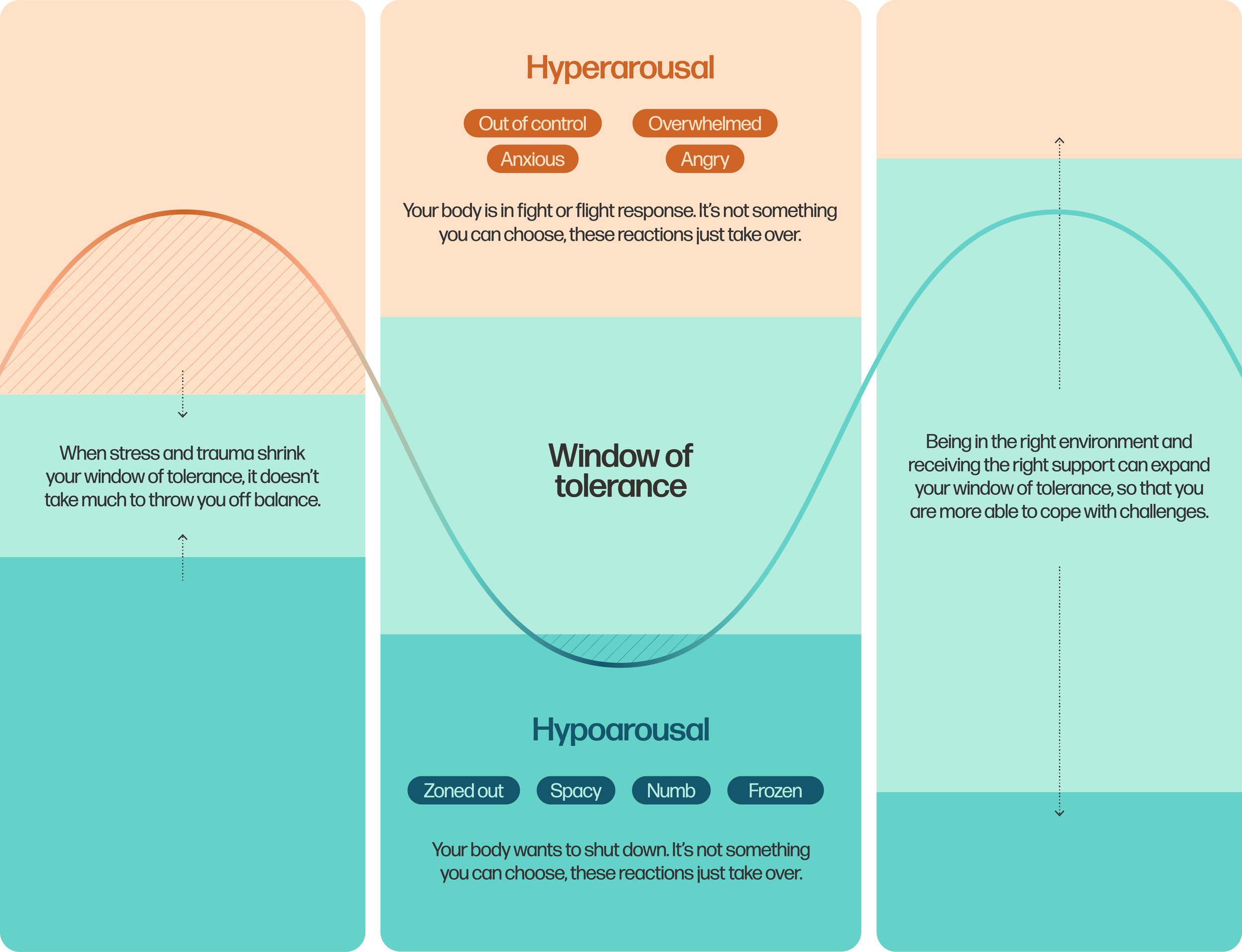
Meltdowns and shutdowns are natural and adaptive responses of a Neurodivergent individual to dysregulation and distress. Neurodivergent people typically have a smaller window of tolerance (Buczynski, 2017) – our zone of resilience and emotional regulation – because our sensory and nervous systems are often more sensitive and refined. This can be made worse by living and working in environments that do not accommodate our sensory and social processing differences, as well as by prior trauma.
Meltdowns occur when an individual is in a state of hyperarousal, while shutdowns happen during hypo arousal. Both responses emerge when a person is pushed beyond their window of tolerance. Understanding these differences can help us to empathise with the experiences of Neurodivergent individuals and support them practically.
What is the window of tolerance and capacity? (Dr Dan Seigel)
The window of tolerance is often described as our zone of resilience—the state in which we can manage everyday stressors, stay regulated, and function effectively. Within this window, our nervous system can process arousal and emotional experiences without becoming overwhelmed. Our capacity refers to how much we can be with, tolerate, and digest the emotions, sensations, and experiences of the present moment.
It is important to note that if someone’s window of tolerance is small to begin with (due to stress, trauma, the sensory environment or social processing differences) escalation and dysregulation can happen rapidly. In addition, everyone has varying limits in what they can tolerate physically, emotionally, socially, spiritually, psychologically, and verbally. Being able to identify signs of dysregulation in ourselves and others and choosing to de-escalate through self-soothing and co-regulation is key.
Meltdown
Hyperarousal
Hyperarousal can occur when a Neurodivergent person experiences overstimulation (sensory, emotional, processing) or overwhelm, triggering a fight-orflight nervous system response
Regulating behaviours
In response to hyperarousal and sensory overload, individuals may engage in regulating behaviours such as covering their ears, wearing headphones, withdrawing from communal spaces, sitting in lowlight environments, or using repetitive movements like rocking, spinning, or twirling their hair. These responses are adaptive attempts to manage overwhelming sensory input. Staying attuned to our nervous system states can help us respond in ways that support a return to regulation and reduce overall arousal. During these moments, support from others is often essential.
Hyperarousal to meltdown
This state of hyperarousal can in turn lead to increased sensitivity to sensory and social input, becoming a feedback loop of escalating arousal and sympathetic activation. This is what we call ‘meltdown’.
What it looks like
Meltdowns can lead to a Neurodivergent person appearing angry or distressed. This could manifest as shouting, crying, swearing, kicking, stamping, pacing or trying to run away. It can look like a volcano erupting or a dam bursting, resulting in an uncontrollable flood of emotions, sensations and energy. Individuals may experience a loss of ability to think clearly or engage.
What it means
These actions are a person’s attempt to release the energy from nervous system arousal—manifesting as a fight, flight, or related emotional response—to regulate themselves, reduce overwhelm and return to their window of tolerance. Dysregulation and hyperarousal are frequently proportionate to the level of stress a person is experiencing. These behaviours and emotional expressions often communicate a clear “no” or signal distress arising from a heightened state of arousal.
How it may be misunderstood
It is important to note that these behaviours are not the person being deliberately challenging or disruptive. These actions are not intended to harm; they are an involuntary response to extreme anxiety and overwhelm.
Important considerations
Distress and dysregulation are sometimes misunderstood or labelled as aggression or violence. It may be helpful to acknowledge that while violence is never acceptable, there is an important context to consider, particularly in inpatient settings. Many individuals become overwhelmed in environments that are poorly designed, lack appropriate support or are not responsive to their needs. In such cases, this misunderstanding can lead to serious consequences, including people being placed in, or remaining in, secure units or long-term segregation and acquiring a criminal record for actions that occurred during periods of acute distress whilst in hospital.
Supportive responses for meltdowns
1. Core approach
Affirming and supportive responses involve safely supporting the release of energy, deescalating and co-regulating with the individual. Using a non-reactive and gentle tone is essential. Rather than dismissing or attempting to suppress what the individual is feeling with quick strategies, we should acknowledge and validate these feelings.
2. Immediate safety
It is crucial to avoid physical contact, clear the space to prevent self-harm, maintain a safe distance, avoid eye contact, and remove others from the area to reduce social input.
3. Communication
Speaking minimally can help reduce information overload and social processing.
4. During the meltdown
It is beneficial to wait until the release of energy has passed before intervening.
5. Supporting recovery
Gently support their return to regulation, offering calming items, sensory tools, a drink, or safe food.
6. Emotional support
Sometimes reminding the person about their passions or interests can help, but it is important to concentrate on supporting the body and sensory soothing first.
7. Reflection & future support
It is also important to recognise the sensory and social factors that contributed to the meltdown. Affirm your commitment to making accommodations and providing support to ensure a low-arousal environment in the future.
Shutdown
Hypoarousal
Hypoarousal can occur when a Neurodivergent person experiences understimulation, exhaustion, or shutdown, leading to a reduced or “freeze” nervous system response. This may follow prolonged stress, overwhelm, or burnout, where the body conserves energy and disengages.
Regulating behaviours
In response to hypoarousal, individuals may engage in regulating behaviours such as seeking sensory input (e.g. movement, pressure, touch), increasing stimulation (music, fidgeting, pacing), or using routines and prompts to support activation. Others may withdraw, appear unresponsive, or have difficulty initiating tasks or communication. These responses are adaptive attempts to restore balance and re-engage the nervous system. Staying attuned to our nervous system states can help us recognise hypoarousal and respond with appropriate support, gradually increasing stimulation in a safe and manageable way. During these moments, support from others is often essential.
Hypoarousal to shutdown
In contrast to a meltdown, where heightened energy is expressed outwardly, hypoarousal involves a turning inward. The nervous system shifts into a state of conservation and protection, resulting in reduced movement, minimal communication, and low energy. A person in this state may appear non-reactive, non-speaking, or emotionally absent, and may have difficulty initiating even simple actions.
What it looks like
A Neurodivergent person experiencing hypoarousal may become physically still, withdrawn, and significantly less responsive to their environment. They might stop speaking all together, struggle to answer questions, or appear disconnected from what is happening around them. Physically, this can present as curling up, lying down, or remaining in one position for extended periods. Speech may feel effortful or inaccessible, and the individual may be unable to communicate their needs. Many also experience intense fatigue, heaviness in the body, or a sense of “shutting down.”
What it means
Hypoarousal occurs when an individual becomes overwhelmed to the extent that it triggers a freeze response. This response leads to dissociation, numbness, and a reduced ability to process sensory, social, and information input. It can feel like a sense of absence or emptiness.
How it may be misunderstood
This state is often misunderstood, as the individual may seem calm on the surface, when in fact they are experiencing an intense form of nervous system shutdown. What might seem like non-compliance, challenging behaviour, or a refusal to communicate is a shutdown—it is the nervous system’s way of protecting itself from extreme overwhelm and perceived threat.
Important considerations
It is important to recognise that hypoarousal is not a choice or a lack of engagement, but an adaptive response to overwhelm. Support during these moments should focus on safety, gentle presence, and reducing demands, allowing the person’s nervous system the time and space it needs to gradually return to a more regulated state.
Supportive responses for shutdowns
1. Core approach
Affirming and supportive responses involve co-regulation and providing sensory support. Keeping your tone gentle and nonreactive is crucial.
2. Sensory support & environment
This can include offering items like a weighted blanket or familiar comforting objects, while also reducing environmental stimuli such as bright lights, loud noises, crowded spaces, and strong smells.
3. Presence & reassurance
It is essential to offer the person ‘presence’, reassuring them that you will support them through this experience without placing any pressure on them, as shutdowns can take time to resolve.
4. Environment during shutdown
Maintaining a quiet, low-demand, and low-arousal space helps facilitate recovery.
5. Supporting recovery
When the individual feels ready, gently assist them back into a co-regulated state – such as discussing their passions – but focus on body comfort and soothing first.
6. Reflection & future support
It is also important to recognise the sensory and social factors that contributed to the shutdown and to commit to making accommodations. Providing ongoing support to ensure a low-arousal environment in the future is vital.
Conclusion
Meltdowns and shutdowns can be minimised by creating low-arousal environments that focus on regulation and sensory wellbeing. Providing a Neurodivergent individual with a supportive, predictable and accommodating space can both reduce feelings of overwhelm and distress and support an increase in their window of tolerance.
The SPACE framework (Doherty et al., 2023) – sensory needs, predictability, acceptance, communication and empathy – offers a structured approach to promoting regulation. By emphasising safety, maintaining consistent routines, making necessary accommodations and creating sensoryfriendly spaces, using clear and compassionate communication and responding with empathy, we can create environments that meet Neurodivergent needs and safeguard against meltdowns and shutdowns.
LEARN MORE IN OUR TOOLKIT
-
Buczynski, R. (2017, November 2). How to help your clients understand their window of tolerance. NICABM. https://www.nicabm. com/trauma-how-to-help-your-clients-understand-their-window-of-tolerance/
Doherty, M., McCowan, S., & Shaw, S. C. (2023). Autistic SPACE: A novel framework for meeting the needs of autistic people in healthcare settings. British Journal of Hospital Medicine, 84(4), 1–9. https://doi.org/10.12968/hmed.2023.0006
Glossary
Adaptive
Actions or strategies that help a person function effectively in everyday life.
Capacity
The extent to which we can be with, tolerate, and process the feelings, emotions, sensations and nervous system activation we are experiencing in the present moment, alongside the sensory, social, and information input in the environment we are in.
Co-regulation
The process whereby people help each other regulate their emotional and nervous system states.
Dysregulation
When the nervous system exceeds its capacity and goes beyond the window of tolerance, stressors cannot be processed, emotions and sensations become uncontainable, leading to a meltdown and shutdown.
Fawn
The nervous system survival response of people-pleasing and trying to appease an aggressor or perceived threat, avoiding conflict to ensure safety.
Fight
The nervous system’s survival response to perceived danger, where the body prepares to confront and defend against the threat.
Flight
The nervous system’s survival response to perceived danger, where the body prepares to run away and escape from the threat.
Freeze
The nervous system’s survival mechanism of becoming immobile, numb, disconnected and collapsed in response to a perceived threat.
Hyperarousal
When our body feels like it is on high alert all the time. We might feel anxious, restless or overly sensitive to things like noise or touch.
Hypoarousal
When our body feels sluggish or underactive, like we are drained of energy or not fully alert. We might feel tired, numb or have trouble focusing, as if everything is moving in slow motion or we are disconnected from what is happening around us.
Meltdown
When a Neurodivergent person experiences overstimulation and overwhelm, triggering a fight-orflight response.
Nervous system
Includes the brain, spinal cord and a complex network of nerves that controls all body functions. This system sends messages back and forth between the brain and the body and vice versa.
Regulation
The ability to tolerate stressors and process, digest, and complete nervous system activation (fight/ flight/fawn/freeze energies) without moving beyond our capacity and window of tolerance (known as our zone of resilience) and into dysregulation.
Shutdown
When an individual becomes overwhelmed to the extent that it triggers a freeze response.
Stressors
Any event, situation or external stimulus that causes a stress and nervous system survival response in the body.
Neurodivergent Wellbeing Approach
Want to learn more?
Our Neurodivergent Wellbeing Approach online training course explores this topic in more detail across eight chapters.
This course is a holistic, Neurodivergent-friendly wellbeing curriculum that offers a reflective space, education, and practical strategies for Neurodivergent individuals, their family members, friends, caregivers, and professionals who support them.