 Image 1 of 1
Introduction
This guide aims to validate and affirm the diverse ways Autistic people respond to trauma while providing Neurodivergent-friendly coping strategies. Whilst the guide is Autism focused, we believe that the content may be relevant across all Neurodivergence and perhaps for people of all neurotypes.
What are trauma responses in Autistic people?
Trauma responses in Autistic individuals can look different from those in neurotypical people, and recognising these differences is essential for understanding and appropriate support. Traditional models of trauma responses – fight, flight, freeze and fawn – and the hierarchy and indicators of the Autonomic Nervous System (ANS) states – relaxed (Parasympathetic Ventral Vagal), mobilised (Sympathetic) and immobilised (Parasympathetic Dorsal Vagal) – may manifest uniquely in Autistic individuals due to sensory sensitivities, and communication, social and information processing differences (Polyvagal Institute, 2024; Porges, 2011; Trauma Geek, 2023).
What we are conditioned to believe are prosocial behaviours:
“... soft gaze, expressive face, eye contact, smiling, vocal resonance, turning towards others, and comfort with sharing touch. Many of these social behaviours are neurotypical cultural expectations. Additionally, these behaviours do not always demonstrate that a person is feeling safe internally. Neurodivergent people can perform these behaviours while in a trauma response called fawning or masking”
—Trauma Geek, 2023
What is Polyvagal Theory?
Polyvagal Theory explains how the nervous system responds to safety, stress, and danger. Developed by neuroscientist Dr Stephen Porges, it describes how the body and brain work together to shape our reactions to everyday challenges and more intense experiences such as trauma. The theory outlines three main nervous system states: mobilisation (fight or flight), immobilisation (shutdown or collapse), and social engagement, which occurs when we feel safe and connected. These states exist along a continuum that we move through daily and are managed by the vagus nerve, which links the brain and body.
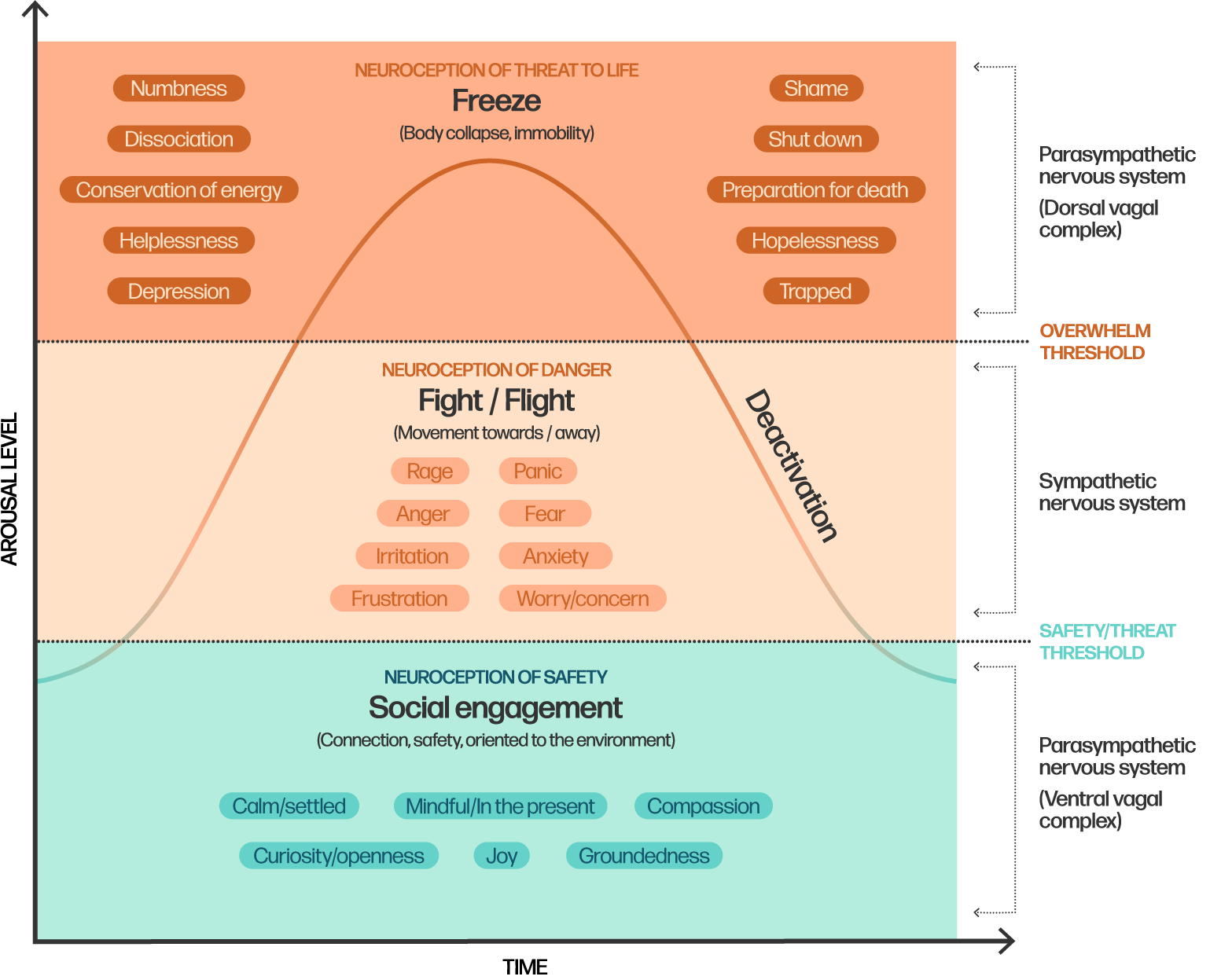
Understanding trauma responses in Autistic individuals and neurodiversity-affirming strategies for support
Fight response
The fight response is a natural and adaptive self-defence reaction to a perceived threat. This reaction, which may be labelled as challenging behaviour, aggression, or defiance by an external observer, is a healthy response.
In Autistic individuals, this may present as:
Meltdowns triggered by overwhelming stimuli.
Strong verbal or physical resistance to perceived threats.
Repetitive questioning or arguing to regain a sense of autonomy.
Affirming strategies
De-escalate and coregulate with the person.
Recognise that meltdowns are distress responses, not intentionally challenging behaviour.
Allow for self-regulation through stimming or movement.
Provide clear communication and explanations, choices and warnings before transitions, and mutually agreed predictable routines.
Flight response
Flight involves an adaptive, natural and healthy escaping response from a distressing situation.
In Autistic individuals, this may present as:
Bolting or running away (often from sensory overload or confrontation).
Shutting down conversations or avoiding interactions.
Using specific interests or passions as a means of mental escape.
Increased stimming and distress.
Affirming strategies
De-escalate and coregulate with the person.
Ensure access to safe spaces where time-out is allowed without repercussions or questions.
Offer noise-cancelling headphones and/or other sensory aids.
Allow engagement in special interests as a grounding technique.
Freeze response
Freeze is an adaptive, natural and healthy nervous system response which occurs when the body becomes immobilised due to fear or overwhelm and when the person cannot fight or flight (escape) the stressor.
In Autistic individuals, this may present as:
Situational mutism or difficulty speaking in distress.
Staring blankly or becoming unresponsive.
Immobilisation, being unable to move or act
Affirming strategies
De-escalate and coregulate with the person.
Avoid pressuring the individual to respond or do anything
Sit alongside the person at a small distance, avoid eye contact and provide kind and compassionate words of reassurance.
Reduce any stimulus in the social and sensory environment and provide the person with sensory support items, like a weighted blanket.
Provide alternative communication tools if speech is difficult.
Allow time for processing without rushing or demanding an outcome or explanation.
Fawn response
Fawning is a lesser-known trauma response involving the adaptive and natural nervous system response of people-pleasing to avoid conflict and appease the threat (Trauma Geek, 2021a).
In Autistic individuals, this may present as:
Masking or suppressing Autistic traits to fit in and feel safe
Excessive apologies or compliance.
Difficulty setting boundaries due to fear of rejection.
Affirming strategies
De-escalate and coregulate with the person.
Be an ally and advocate - encouraging authenticity, rather than compliance.
Reinforce that their needs and boundaries matter.
Model and teach consent-based communication and self-advocacy.
Additional considerations for trauma responses in Autistic people
Sensory processing and trauma
Sensory sensitivities can amplify or cause trauma responses. Overwhelming environments may trigger trauma responses, especially as Autistic people have more reactive and refined nervous systems, even in situations that seem neutral to others. Therefore, create low-stimulus environments when possible and validate sensory sensitivities as real and important.
Other processing differences
Autistic individuals may have a different relationship with processing emotions and memories, especially if they experience alexithymia. Delayed responses to trauma, stress and grief are common. Monotropic and literal thinking may also affect how trauma is perceived and processed.
Masking, invalidation and trauma accumulation
Masking involves concealing Autistic traits to fit into societal expectations, which can lead to Post Traumatic Stress Disorder (PTSD) and significant mental and physical health challenges.
While it may help navigate social situations, the chronic masking and stress required by Autistic people in navigating a world which is built for and validates the neurotypical experience often results in burnout, anxiety, depression, and a loss of identity.
Encouraging environments where Autistic individuals feel safe to express themselves without masking is essential for mental wellbeing. Long-term masking can contribute to complex trauma (Pearson & Rose, 2023). Therefore, normalise Autistic culture and create safe spaces of inclusion and belonging, where unmasking can happen without judgment.
Autistic traits or trauma responses
It is important to distinguish between inherent divergence, Autistic traits and trauma-induced distress responses:
Autistic traits
Natural and innate characteristics, such as:
Heightened sensory sensitivities
Stimming (repetitive movements for self-regulation)
Meltdowns
Avoidance of eye contact
Monotropism
Bottom-up processing
Strong need for autonomy, routine and predictability
Trauma responses
Trauma can lead to responses like:
Increased hypersensitivity beyond one’s baseline
Suppression of stimming
Shutdowns
Forced eye contact
Submission to social and sensorychallenging environments
Internal demand avoidance
Dissociation
Masking (hiding true self)
Increased self-harm
Shame
Negative self-image
Healing from trauma requires neurodiversity-affirming approaches and does not aim to make an Autistic person more neurotypical. Instead, it aims to reduce trauma, allowing the individual to express their authentic Autistic self. Therefore:
“Autistic individuals may need more support after trauma interventions, not less”
— Trauma Geek, 2021b
Minimising trauma and supporting Autistic individuals in trauma recovery
Centre regulation and wellbeing
Create nervous system-informed, body-focused cultures of regulation, wellbeing and deescalation, where collective and coregulation are paramount.
Be an ally and advocate
Become the person who actively challenges prejudice, discrimination and victimisation of Autistic people.
Provide Neurodivergent and trauma-informed care
Utilise therapeutic approaches that acknowledge the unique ways trauma manifests in Autistic individuals and tailor interventions to sensory, social and information-processing differences and experiences of alexithymia.
Create safe environments
Reduce sensory overload and provide predictable routines.
Encourage authenticity
Allow individuals to express their Autistic traits without judgment.
Promote self-acceptance
Help individuals understand and embrace their Neurodivergent identity.
Final thoughts
Understanding trauma responses through a Neurodivergent-affirming lens is essential to supporting Autistic individuals. Rather than viewing these responses as dysfunctional, we must recognise them as valid, adaptive and natural survival mechanisms. By fostering environments of acceptance, predictability and support, we can help reduce trauma for Autistic people and help them navigate and cope with trauma in ways that honour their Neurodivergence.
-
Pearson, A., & Rose, K. (2023). Autistic masking. Pavilion.
https://www.polyvagalinstitute.org
-
Pearson, A., & Rose, K. (2023). Autistic masking. Pavilion.
Polyvagal Institute. (2024). What is polyvagal theory? https://www.polyvagalinstitute.org/whatispolyvagaltheory
Porges, S. W. (2011). The polyvagal theory: Neurophysiological foundations of emotions, attachment, communication, and selfregulation. Norton.
Trauma Geek. (2021a). Autistic traits vs autistic trauma. https://www.traumageek.com/blog/autistic-traits-and-trauma
Trauma Geek. (2021b). Fawn: The trauma response that is easiest to miss. https://www.traumageek.com/blog/fawn-the-trauma-response-that-is-easiest-to-miss
Trauma Geek. (2023). A neurodiversity paradigm lens on polyvagal theory. https://www.traumageek.com/blog/a-neurodiversity-paradigm-lens-on-polyvagal-theory
Neurodivergent Wellbeing Approach
Want to learn more?
Our Neurodivergent Wellbeing Approach online training course explores this topic in more detail across eight chapters.
This course is a holistic, Neurodivergent-friendly wellbeing curriculum that offers a reflective space, education, and practical strategies for Neurodivergent individuals, their family members, friends, caregivers, and professionals who support them.