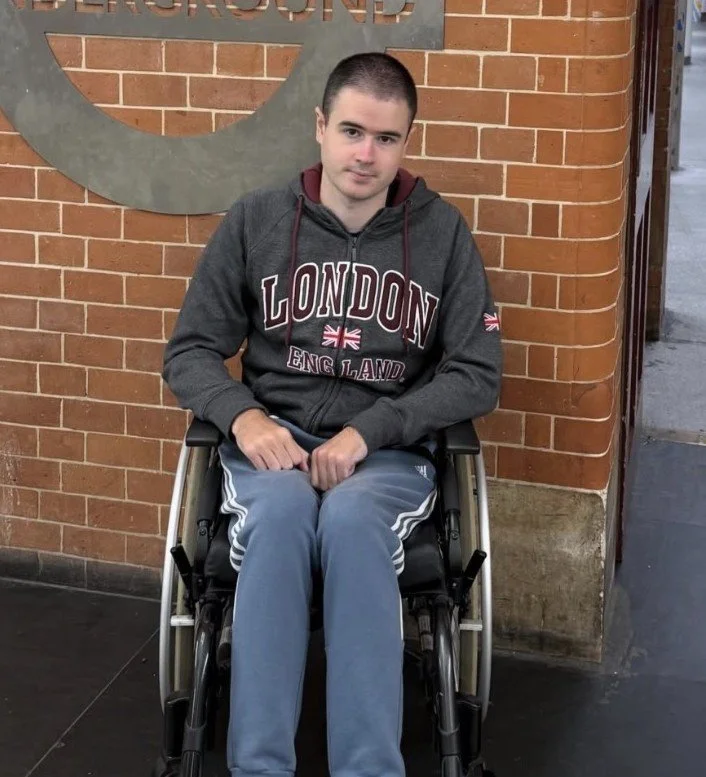
We are joined by Guest Contributor Liam Virgo, who shares his experience of developing severe Functional Neurological Disorder (FND) at the age of thirteen and the impact it has had on his life. In this blog, he reflects on the connection between FND and Neurodivergence, the challenges of navigating education with a disability, and the importance of resilience and hope.
The day my body shut down
Thirteen is usually the age you start to gain some independence. My reality changed in an instant when I was 13. In 2016, I suddenly lost my ability to walk and talk. Within a matter of days, I went from a healthy teenager to one who couldn’t move or even speak.
I spent months in hospital as doctors tried to figure out why my body had simply shut down. Eventually, I was diagnosed with severe Functional Neurological Disorder (FND). For years, I was a teenager locked in a body that had stopped working. I was bedridden as a result of my condition. Developing a severe physical disability as a teenager is an isolating experience. I was suddenly forced to rely on others for everything.
The overlap: FND and Neurodivergence
Early in my medical journey, healthcare professionals noticed specific patterns in my behaviour and communication. Because of the sudden drop-off in my ability to speak and interact, specialists initially thought I might be experiencing Autistic regression. This is a phenomenon where an individual loses previously acquired social, language, or motor skills.
This possibility led to a referral to the Child and Adolescent Mental Health Services (CAMHS) a few years later, where I underwent formal Autism assessments. While the formal conclusion was that I displayed strong Autistic traits rather than a full diagnosis at that time, it opened up a vital conversation about the deep, intricate link between FND and Neurodivergence.
Medical research and lived experiences increasingly show that the Neurodivergent brain and FND are deeply interconnected. FND is fundamentally a problem with how the brain and nervous system send and receive signals—it is a glitch in the "software" of the body rather than structural "hardware" damage. For Neurodivergent individuals, whose nervous systems already process sensory, emotional, and environmental inputs differently, the vulnerability to signal disruptions like FND can be much higher.
When traditional environments fail
Because of the unrelenting physical and mental health challenges brought on by severe FND, returning to a traditional school environment became impossible after being bedridden. The fast-paced, highly sensory, and rigid structure of a standard school building simply does not accommodate a nervous system in crisis. Instead, I had alternative provision through home tutoring.
My experience highlighted a major flaw in our educational systems: traditional school environments are frequently not built to support young people who process the world differently. Whether due to physical disability, chronic illness, or Neurodivergence, forcing a non-traditional mind or body into a rigid environment often leads to burnout and exclusion. We need educational pathways that adapt to the individual, rather than forcing vulnerable teenagers to break themselves trying to fit a mould.
Determination and a message of hope
Living with severe FND meant rewriting the script for my life. It would have been easy to let the diagnosis define my limits forever, but as the years progressed, I became fiercely determined not to let my disability hold me back. I had to relearn how to navigate the world, advocate for my own health, and find new ways to communicate my truth.
If you are a young person reading this while currently feeling trapped in your own body, or if you are struggling to make sense of a neurotypical world that feels too overwhelming, I want to give you a message of hope:
Hope is a tiny spark that can survive the darkest of nights. Getting better and finding your way doesn’t happen in a straight line. There will be days when the frustration feels absolute. But a nervous system that is highly sensitive is also capable of incredible resilience. Being Neurodivergent or living with a condition like FND does not mean your life has paused permanently; it just means you are operating on a different, unique timeline. 10 years on from my brain shut down and I’m now adjusting to life post severe FND, plus learning to live with my new normal. Although the emotional and physical scars that FND has left me with are still felt, I’m determined to never give up hope for the future. I lost my abilities at 13 but one thing that FND could never take away from me is my determination.